
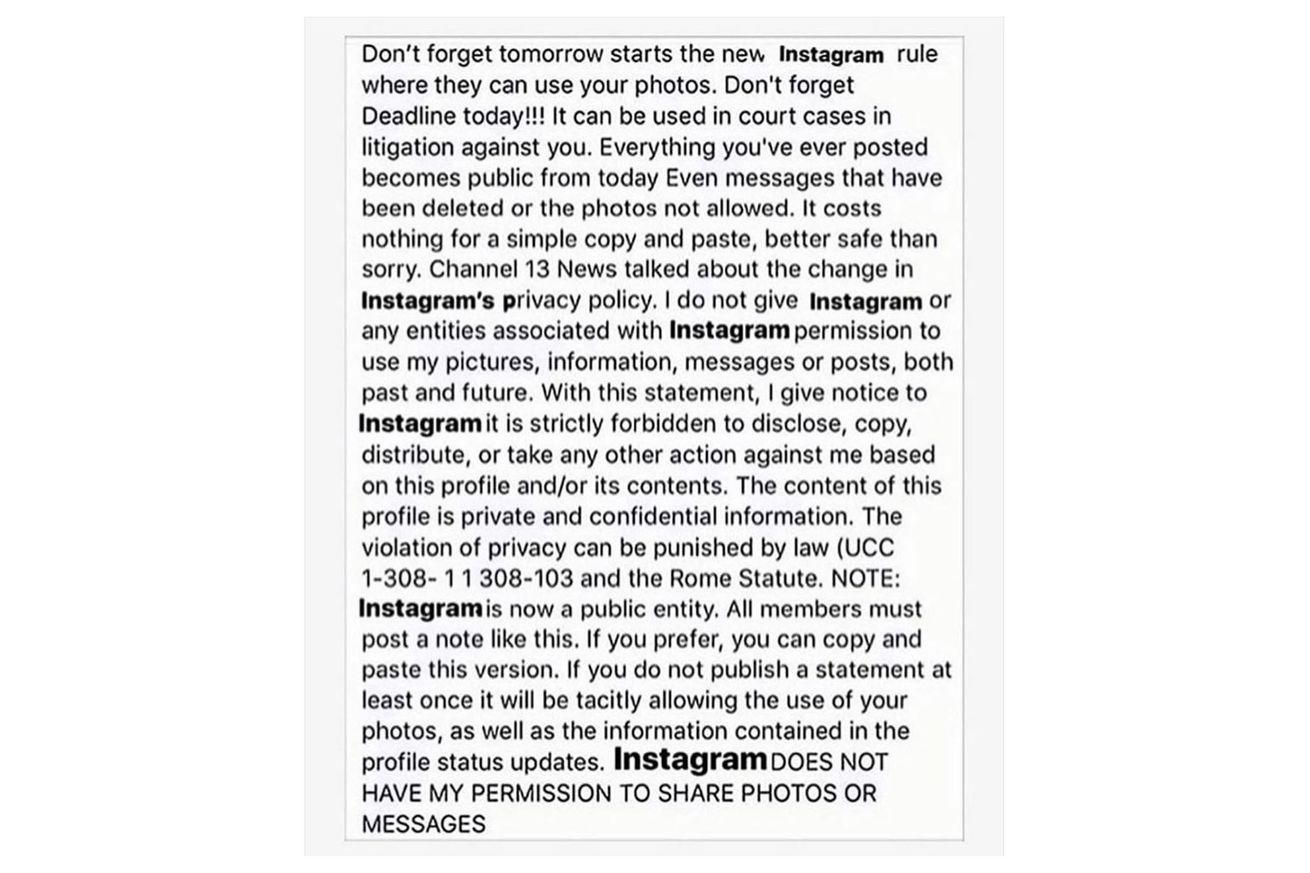
Famous actors and musicians, the head of the US Department of Energy, and regular Instagram users have been spreading a hoax memo that claims the company will soon have permission to make deleted photos and messages public and use those posts against them in court.
The claims are fake, and the assertions don’t make a lot of sense, but that hasn’t stopped it from being spread by some major names concerned about the implications. Celebrities including Usher, Judd Apatow, and Julia Roberts posted the note to their feeds, as did Rick Perry, the current United States Secretary of Energy and former Texas Governor. The note and similar ones have been going around since 2012, and this is just their most recent resurgence.
“There’s no truth to this post.”
The copied-and-pasted note has been spreading over the past day, warning of supposed changes to Instagram’s privacy policy that’ll give Instagram the power to “use your photos” in various ways without consent.
The note includes a purported opt-out message that claims to forbid Instagram from using a person’s information or “disclosing, copying, distributing, or taking” any action against them based on what’s posted to their profile. It says their profiles hold “private and confidential information.”
It’s a total farce. “There’s no truth to this post,” Stephanie Otway, a spokesperson for Facebook, which owns Instagram, tells The Verge.
View this post on Instagram
A post shared by Usher (@usher) on
To put it simply: this message accomplishes nothing and makes no sense. Posting it on Instagram doesn’t affect how Instagram treats your content.
Instagram’s policies grant it some basic uses of your photos and messages because it needs permission to display them to other users. As a clarification, the company’s terms of service includes a bolded line that reads “We do not claim ownership of your content, but you grant us a license to use it.” It also says you can end that license at any time “by deleting your content or account.”
The legal citations don’t make a lot of sense
Instagram can also share data and content with law enforcement, and it does so in response to warrants, court orders, or when believed it is necessary to prevent a crime. This is true of all internet services. These companies comply with legal requests from law enforcement and turn over whatever information they have, including account details and posts.
The legal citations in the hoax also don’t make a lot of sense: the UCC is the Uniform Commercial Code, which forms the basis of state-level contract law and generally doesn’t apply to copyright issues, and there’s no such thing as UCC 1-308-11308. The closest thing, UCC 1-308, is in the definitions section and doesn’t have any penalties, and it’s mostly about reserving the right to sue even if you accept defective goods. The Rome Statute established the International Criminal Court in 1998, and, well, the ICC doesn’t really care about your Instagram.
Using free services like Instagram, Facebook, Snapchat, and Twitter means agreeing to their terms and privacy policies. It also means accepting the fact that they can access your account details if necessary to assist in legal investigations. The only option to avoid this is to quit the services entirely. That said, the way in which this hoax spread likely speaks to the fact that people worry about how much control they really have over their own data.
The unfortunate reality is that you don’t fully control anything you share online, so long as you’re using someone’s else’s service.
Original Article ©Copyrights theverge.com


No comments
Post a Comment